How WattAnyWhere can complement the grid, solar and batteries with dispatchable on-site generation – and what three live demonstrations have already shown.
The energy system is becoming more distributed – and more demanding.
Europe is trying to expand and modernise its electricity networks. In June 2026, EU energy ministers backed the European Grids Package, explicitly aimed at accelerating grid development, permitting, electrification and resilience. For individual sites, however, new electricity demand appear much faster than new network capacity.
That creates a practical question for supermarkets, service areas, campuses, logistics sites and other commercial or industrial facilities: how do you add power, resilience and new electrical services without making every expansion dependent on a larger grid connection?
01 | The power challenge
Commercial and industrial sites are taking on more electrical load: EV charging, refrigeration, HVAC, digital infrastructure and electrified processes. At the same time, rooftop solar and batteries are increasingly part of the site energy mix.
But those assets do not remove every constraint. Sites can still face:
- insufficient available grid capacity for new loads;
- long or costly grid reinforcement;
- high peak-demand exposure;
- large area requirements for solar PV when hundreds of kilowatts of additional on-site capacity are needed;
- loss of solar production when the grid is unavailable and the local system lacks a stable grid-forming reference;
- limited backup capability during outages;
- difficulty adding services such as high-power EV charging without increasing contracted power.
A resilient microgrid therefore needs more than generation or storage in isolation. It needs technologies that can work together – and a source of power that remains available when solar production falls, batteries need to preserve state of charge, or the external grid cannot supply enough capacity.
02 | Why conventional options are not always enough
The grid remains essential, but additional capacity may require reinforcement, permitting and civil works that do not match the timetable of a new business load.
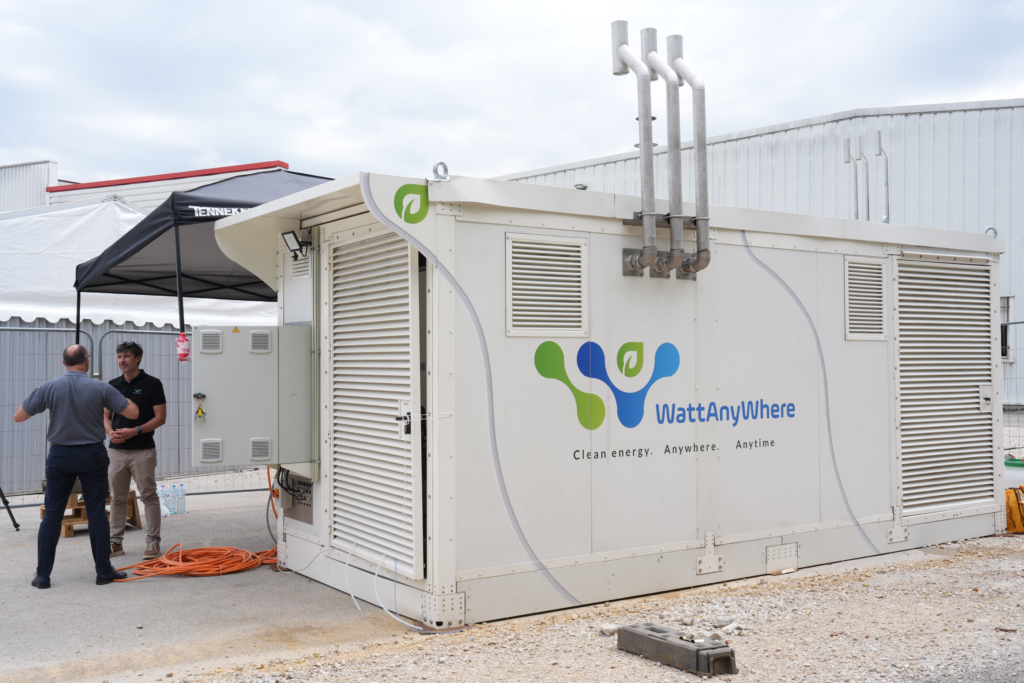
Solar PV creates low-carbon electricity on site, but output varies with weather and time of day. In some microgrid architectures, solar may also need a stable voltage/frequency reference to remain useful when the public grid is down. Space can also become a practical constraint: around 300 kWp of rooftop PV typically requires roughly 1,200–1,800 m² of module area alone, before access, setbacks and spacing, while the WattAnyWhere reference container occupies under 20 m². The comparison is only indicative: 300 kWp of solar is not equivalent to 300 kW of continuous output, so round-the-clock supply would require additional generation and/or storage.
Battery storage is highly effective for fast response, peak shaving and short-duration backup. But batteries shift electricity through time; they do not create new energy and must first be charged.
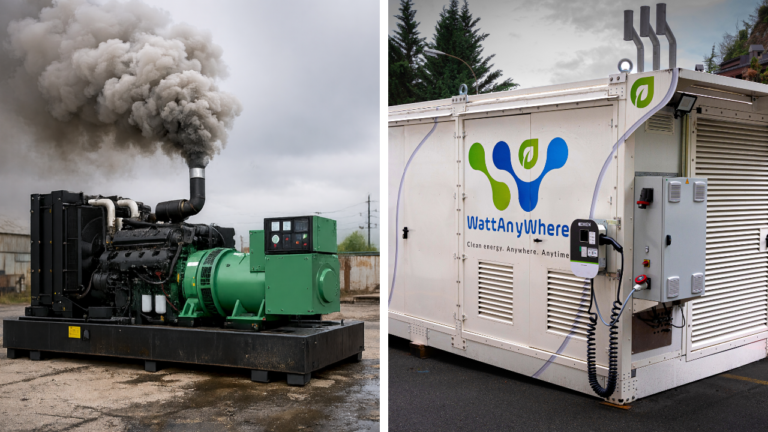
Diesel backup is dispatchable and familiar, but brings combustion, maintenance, noise and local exhaust emissions into a site that may be trying to decarbonise.
The missing layer can be dispatchable local generation: electricity produced on site when the microgrid needs it, rather than stored electricity alone.
03 | The WattAnyWhere solution
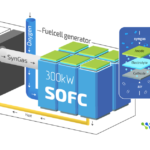
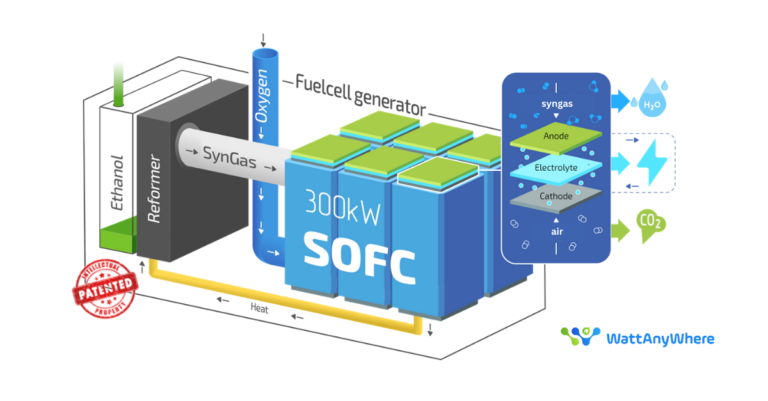
WattAnyWhere converts renewable ethanol into electricity through solid oxide fuel cells (SOFC). The system is designed as a modular, behind-the-meter source of continuous power that can operate within a microgrid alongside the public grid, solar PV, batteries and site loads.
GRID + SOLAR + BATTERY + WATTANYWHERE -> MICROGRID -> SITE LOADS / EV CHARGING
The WattAnyWhere application architecture is built around 300 kW+ scalable power, up to 60% electrical efficiency and 24/7 generation. In practice, the role of the generator can vary by site: supplying baseload, offsetting grid draw, supporting peak consumption, providing additional capacity for EV charging, or contributing to an autonomous microgrid during a grid outage.
04 | What changes on site?
In WattAnyWhere’s microgrid application model, the value proposition is built around four outcomes:
- More local capacity: 300 kW+ scalable generation can add power behind the meter without waiting for the same amount of new grid capacity.
- Continuous generation: Unlike variable solar or finite battery storage, the fuel-cell generator can produce power as long as renewable ethanol is available.
- Resilience: Grid-following and grid-forming capabilities can support a microgrid during normal operation and help maintain a local electrical reference when the external grid is unavailable.
- New services: Additional power can support EV charging and other high-demand loads while reducing pressure on the existing grid connection.
Reference economics. The current WattAnyWhere microgrid one-pager models LCOE below EUR 0.15/kWh, lifecycle impact below 50 g CO2e/kWh and 50%+ TCO/LCO reduction depending on the alternative displaced. These are application assumptions, not measured customer results; actual economics depend on site load, ethanol price, local electricity tariffs and system configuration.
05 | How it works in practice – three live demonstrations
The microgrid proposition is not based on a single laboratory test. Across three live demonstrations in France, WattAnyWhere has progressively validated deployment, direct electrical integration, EV charging, urban operation and the role of the generator inside increasingly complete microgrid configurations. The examples below are presented from the most recent demonstration to the earliest field validation.
E.Leclerc Valdahon – proving the fuller retail microgrid case
The June 2026 demonstration at E.Leclerc Valdahon brought the application closest to the full commercial microgrid proposition. The supermarket already had solar panels on site, but still faced the two issues that matter most to many energy-intensive sites: what happens when the grid is unavailable, and how to support future growth in electricity demand.
WattAnyWhere connected to the site’s power-board house and fed electricity directly into the supermarket microgrid, immediately reducing grid draw. The installation was completed in less than two days through a plug-in connection, using renewable ethanol as a fuel already familiar through existing distribution channels.
- local clean power available immediately after connection;
- direct contribution to supermarket operations and future site energy needs;
- support for new services such as EV charging;
- grid-forming / synchronisation reference capability designed to help keep local solar useful when the external grid is unavailable;
- a 10 kW live demonstration with a >50 kW next-step pathway;
- high-power, modular units envisaged for future site expansion.
For E.Leclerc owner Yvan Bauer, the interest was precisely the move toward a true microgrid: combining existing solar with an additional dispatchable power source to strengthen autonomy and resilience while enabling customer-facing services such as EV charging.
Dassault Systemes Paris Campus – proving urban, behind-the-meter power and long-duration energy capacity
In May 2026, WattAnyWhere carried out its first urban live demonstration with the 3DEXPERIENCE Lab at Dassault Systemes Paris Campus. The objective moved beyond deployment alone: to show how an urban site can add local power capacity, support EV charging and reduce dependence on grid reinforcement.
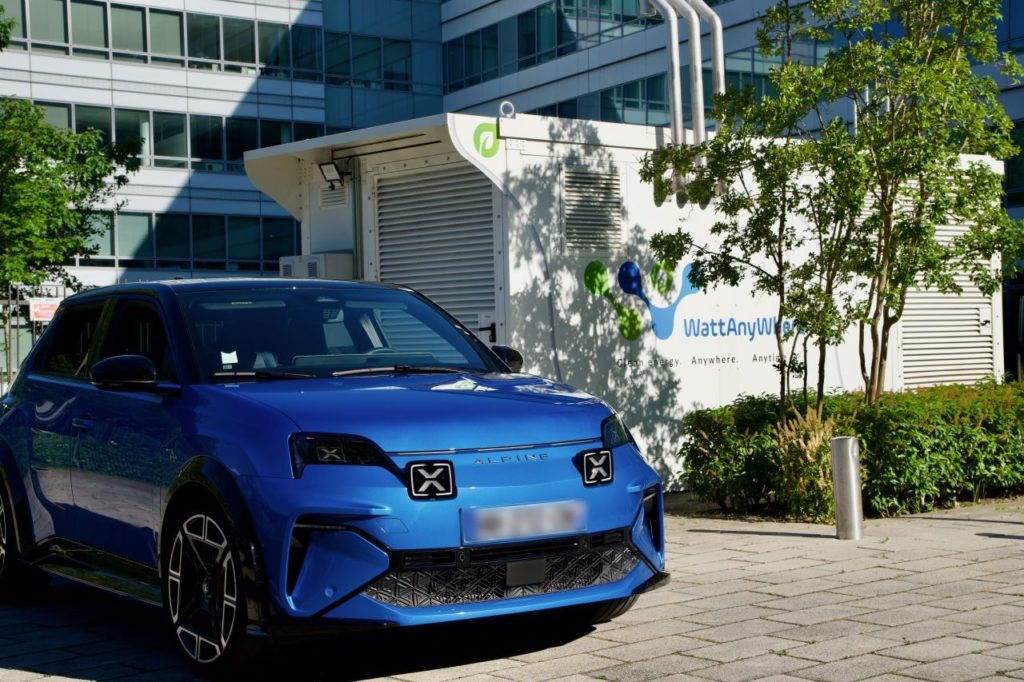
The SOFC generator operated in a microgrid configuration and supplied clean electricity behind the meter. During the demonstration, an Alpine EV was recharged with electricity produced from renewable ethanol – a visible proof of the link between local generation and a real high-power end use.
- instant behind-the-meter power for an urban site;
- support for EV charging and peak consumption;
- additional local energy capacity without relying solely on grid reinforcement;
- low-noise operation and no NOx, SOx or particulate emissions at point of use;
- energy capacity that scales with ethanol storage rather than battery capacity alone.
The application concept uses a standard 30 m3 ethanol tank as an example of long-duration energy storage, corresponding to about 100 MWh of electrical generation in the WattAnyWhere model. This is particularly relevant for sites that need sustained full-power operation: autonomy can be extended through fuel storage and refuelling rather than only by adding battery containers. Put in EV terms, a single 30 m³ ethanol tank could theoretically provide enough electricity for around 2,000 full EV charges, assuming a 50 kWh battery per vehicle.
Shell de Val Neuvy, A10 – proving field deployment and direct microgrid integration
At the end of 2025, within the Shell GameChanger Accelerator, WattAnyWhere moved through a staged validation pathway from laboratory proof and safety validation to live on-site operation at Shell de Val Neuvy on the A10 motorway.
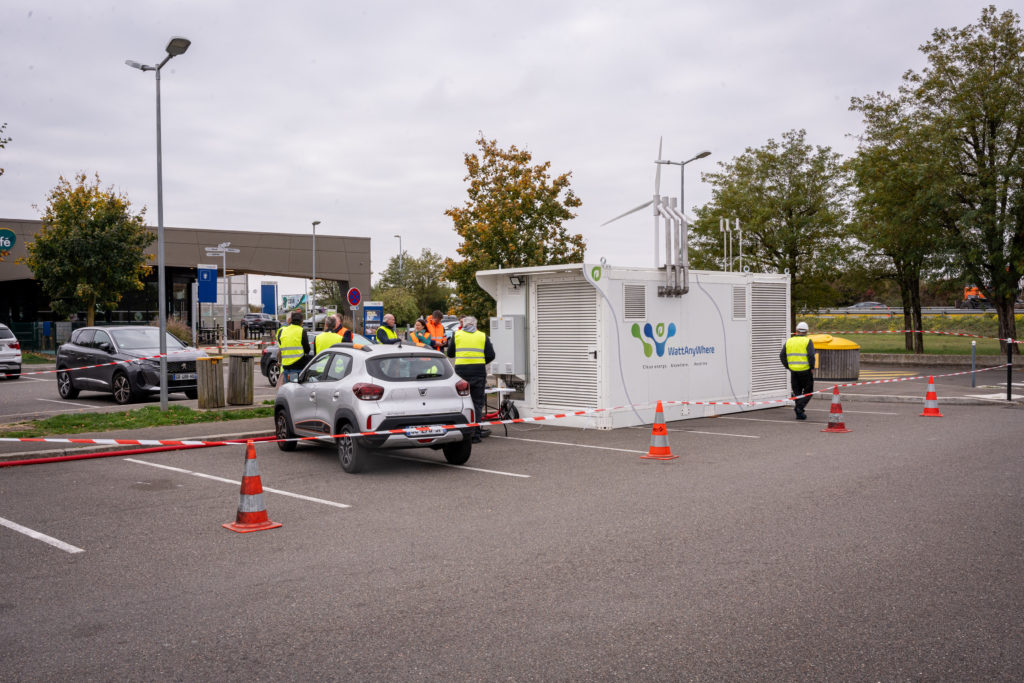
The generator was transported from Switzerland to France, installed in under two days and connected by a simple cable connection to the service area’s power-board house, i.e. behind the meter. It then fed electricity directly into the site microgrid, immediately offsetting grid draw while supporting site loads and EV charging.
- installation in under two days, including cross-border transport;
- stable operation throughout the demonstration;
- direct power injection into the existing site microgrid;
- instant grid-following operation;
- EV charging and site loads supplied from renewable-ethanol electricity;
- a pathway from a 12 kW demonstration toward >50 kW next-stage operation;
- whole-site resilience concept through automated grid-forming.
The importance of Shell was operational: it showed that the system could leave the lab, travel across borders, connect quickly to existing electrical infrastructure and deliver usable power on a real customer site. The demonstration also validated local sourcing of renewable ethanol and the use of a local electrical company to connect the genset to the site’s low-voltage panel, strengthening the case for practical deployment using local supply and installation partners.
Across the three demonstrations, WattAnyWhere has validated the same practical deployment chain: rapid installation -> connection to existing low-voltage infrastructure -> behind-the-meter power injection -> support for EV charging and site loads -> integration with solar and resilient microgrid operation.
06 | Why renewable ethanol makes sense in a microgrid
A microgrid needs flexibility not only in power, but also in energy over time. Renewable ethanol adds a different storage dimension to the system: energy can be stored physically as a liquid and converted into electricity when required.
- Dispatchability: Generation is not dependent on sunshine or on a battery having been charged beforehand.
- Long-duration autonomy: Energy reserve scales with tank volume and can be replenished through refuelling.
- Practical logistics: Liquid-fuel storage and distribution are familiar to many service stations, retailers and industrial operators.
- Microgrid complementarity: Ethanol-based generation can work alongside PV and batteries rather than competing with them.
07 | Is WattAnyWhere a fit for your microgrid?
The application is particularly relevant when:
- site loads are approaching the grid connection limit;
- new EV charging or electrification loads are planned;
- grid reinforcement is slow, expensive or operationally difficult;
- solar and batteries are already present but continuous generation is still missing;
- the site needs resilience against grid outages;
- existing solar should remain useful within an islanded or grid-forming microgrid architecture;
- diesel is currently used for backup or supplemental generation;
- the business needs additional capacity now, with a modular pathway to larger power later.
08 | What the demonstrations have validated
The key point is no longer simply that renewable-ethanol SOFC generation can work. The recent demonstrations have tested how it fits into real electrical environments.
E.Leclerc demonstrated the fuller retail microgrid proposition, combining existing solar with dispatchable local generation for resilience and future load growth. Dassault Systemes demonstrated urban behind-the-meter generation, EV charging and the long-duration energy proposition. Shell validated rapid deployment, direct low-voltage connection, real-world operation, local ethanol sourcing and the use of a local electrical installation partner.
That is the role WattAnyWhere is designed to play in a microgrid: not another isolated energy asset, but a dispatchable generation layer that can make solar, batteries and the grid work together more effectively.
Could WattAnyWhere fit your microgrid?
If your site needs more power, stronger resilience or new electrical capacity without waiting for a larger grid connection, let us assess your load profile and model where continuous renewable generation could fit into the energy architecture.