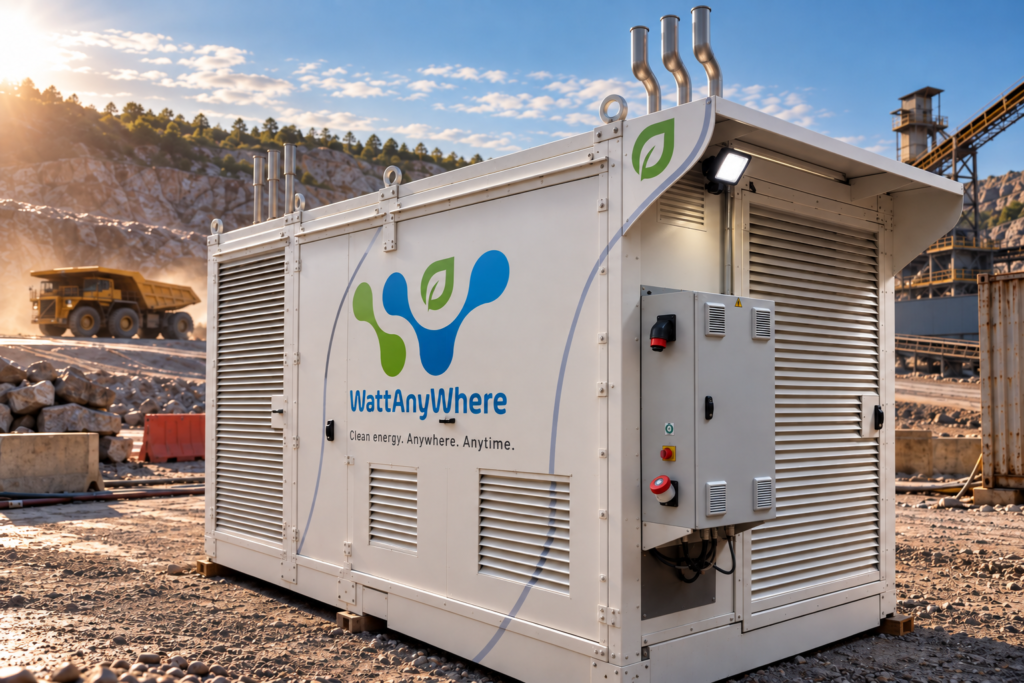
Mining and construction sites need reliable power around the clock. WattAnyWhere replaces diesel gensets with modular, continuous on-site electricity generation, using established liquid-fuel delivery logistics while reducing fuel-cost exposure and operational emissions.
01 | The power challenge
Mining and construction share the same core challenge: temporary or remote sites, limited grid capacity, 24/7 operations and rising electricity demand from equipment and charging. Power must be available whenever and wherever the work happens – and expand as the site grows.
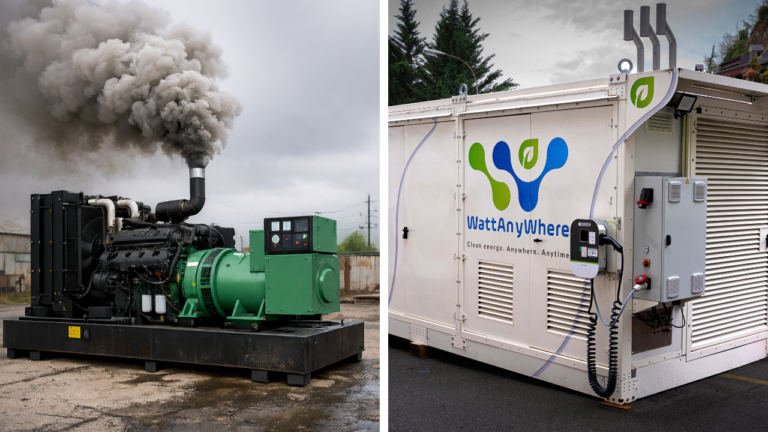
Conventional diesel gensets can meet this demand, but 24-hour operation ties the site to costly, volatile diesel supply, engine servicing, noise and local NOx, SOx and particulate emissions. The financial impact compounds over a ten-year operating period; emissions also affect corporate sustainability reporting.
As more mining and construction equipment is electrified, replacing the diesel generator – not redesigning the whole site – is an immediate route to cleaner, dependable power.
02 | Why conventional options are not always enough
Grid extension can provide large-scale electricity where infrastructure is economically viable, but remote projects may require significant civil works and long lead times.
Diesel gensets are familiar and easy to add, but continuous duty requires more frequent maintenance and exposure to unstable diesel prices. Comparing diesel and renewable-ethanol fuel costs over ten years can reveal substantial potential savings, subject to local prices and utilization.
Solar and batteries can be highly effective components of remote microgrids, but variable renewable generation and finite stored battery energy can make continuous high-power loads difficult to supply with those technologies alone. Storage at this scale can also be costly: WattAnyWhere’s reference ethanol tank holds approximately 100 MWh of fuel energy, compared with around 80 battery containers rated at 1.2 MWh each to reach a similar nominal energy figure. This compares stored energy, not delivered electrical output; usable electricity and total costs depend on system efficiency and configuration.
The opportunity is a drop-in alternative to diesel generation: transportable fuel, continuous output and the freedom to add generation capacity when demand rises.
03 | The WattAnyWhere solution
WattAnyWhere keeps existing liquid-fuel logistics: trucks deliver renewable ethanol to the site, much as fuel is delivered today. The main change is the generating machine – not the overall way the site receives energy. A leased generation setup can further reduce the need for upfront equipment ownership.
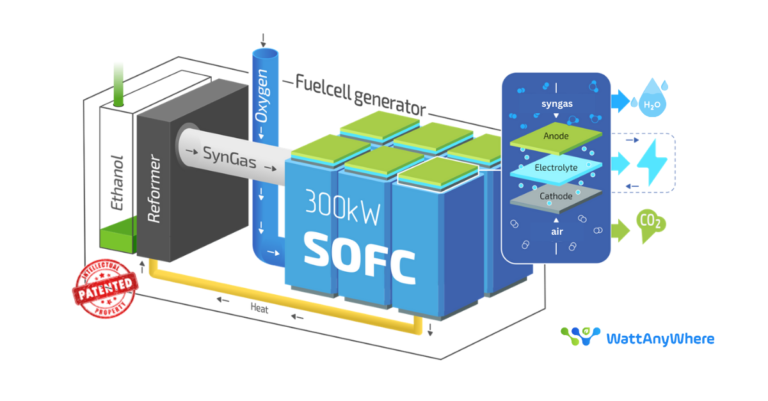
A 300 kW solid oxide fuel cell (SOFC) system converts renewable ethanol into continuous electricity, with electrical efficiency of about 60%. Add more 300 kW gensets as required, just as easily as deploying additional diesel generators or battery units: a modular approach with no predetermined site-wide power ceiling, subject to space, fuel logistics and electrical integration.
Without diesel combustion, the system avoids combustion-related NOx, SOx and particulate emissions at the point of use. Renewable ethanol also offers a pathway to substantially lower lifecycle CO₂ emissions, depending on the fuel supply chain.
|
Renewable ethanol → 300 kW SOFC → Continuous baseload → Mine / construction site |
04 | What changes on site?
WattAnyWhere delivers continuous 24/7 power, starting at 300 kW and offering virtually unlimited scalability by adding gensets as demand grows.
With noise levels of approximately 50 dB versus 70–75 dB for diesel generators, the system significantly reduces noise pollution and eliminates combustion-related local pollutants.
The economic and environmental benefits are equally significant: at least 45%* lower total cost of ownership over ten years and approximately 1,400 tonnes of avoided diesel CO₂ emissions annually for a 300 kW unit operating at 75% average load.
All while maintaining familiar liquid-fuel delivery logistics and the flexibility to expand power capacity as easily as with conventional diesel generators.
*Modelled WattAnyWhere reference comparison versus diesel. Actual 10-year TCO depends on diesel and ethanol prices, operating hours, servicing, logistics and site conditions. CO₂ calculation: 300 kW × 75% × 8,760 hours × 0.7 kg CO₂/kWh ≈ 1,380 tonnes/year of avoided diesel exhaust CO₂; not a lifecycle net-zero claim.
05 | A typical operating scenario
Imagine a remote mining operation or major construction site running diesel generators 24/7 to power equipment, site facilities and increasingly electric machinery. Fuel cost and availability are recurring risks, especially over a ten-year project or fleet life.
WattAnyWhere replaces the diesel genset with a 300 kW renewable-ethanol-powered unit while retaining truck-based liquid-fuel deliveries. More power needed? Add another unit – and another. The same modular, expandable approach used with diesel generators and batteries provides practically unlimited capacity expansion through additional gensets, within normal site and infrastructure constraints.
On a temporary construction site, gensets can be relocated as the project progresses; at a mine, the installation can grow alongside the operation. An equipment-leasing model can simplify deployment and capacity upgrades without changing the site’s basic fuel-delivery routine.
06 | Why renewable ethanol makes sense here
Global availability, familiar logistics. Ethanol is produced worldwide and can be transported and stored using established fuel infrastructure. For mining and construction sites, you change the fuel and the genset, not your existing fuel delivery and storage logistics.
WattAnyWhere converts renewable ethanol into electricity without combustion, significantly reducing local pollutants and lifecycle CO₂ emissions compared with diesel.
For continuous operations, fuel-cost savings over ten years can be substantial, with additional benefits from reduced maintenance. Documented CO₂ reductions may also support access to carbon credits where an eligible methodology, verification process and local market rules apply.Scalability is virtually unlimited: add fuel storage for longer autonomy or additional gensets for more power, just as easily as with diesel generators or batteries.
07 | Is WattAnyWhere a fit for your operation?
- You currently rely on diesel gensets for continuous or frequent site power.
- You want to reduce long-term fuel costs and diesel-price volatility.
- You need flexible power capacity that can grow by adding gensets.
- You need measurable CO₂ reductions for corporate environmental reporting and want to explore potential eligibility for carbon credits, alongside lower local noise and air pollutants
- You want to electrify equipment without waiting for permanent grid infrastructure.
08 | From application to real-world validation
WattAnyWhere has demonstrated autonomous generation at Shell Aire de Val Neuvy, operation in an urban environment during the Dassault Systèmes programme, and integration into a commercial microgrid at E.Leclerc Valdahon.
These demonstrations lay the groundwork for deploying modular renewable-ethanol generation to replace diesel gensets in demanding mining and construction environments.
|
Could WattAnyWhere fit your site? Replacing diesel gensets in mining or construction? Compare ten-year fuel costs, CO₂ reduction and expandable capacity for your site. |