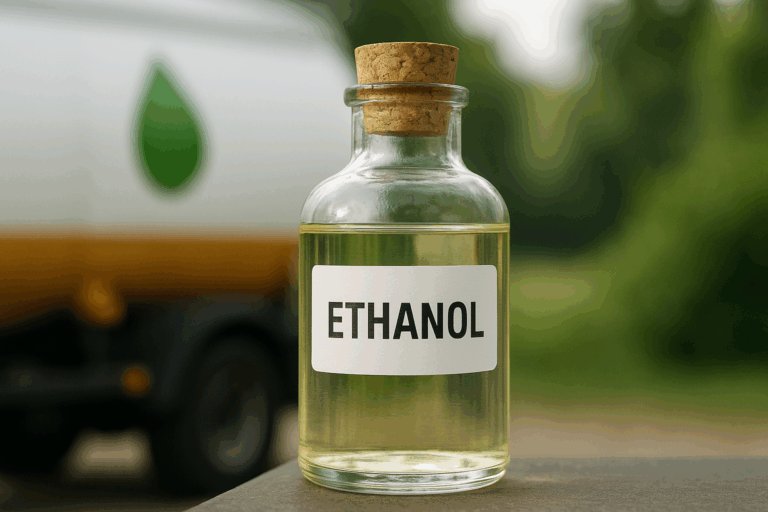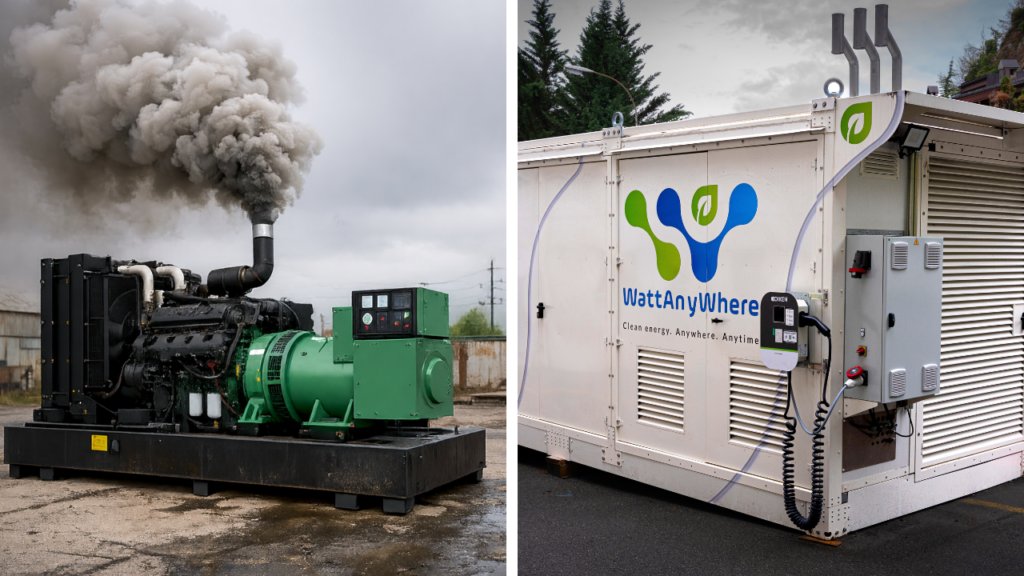
Combustion engines were built for a different era: noisy, maintenance-heavy, and tied to fossil-fuel logistics. WattAnyWhere’s genset use electrochemistry instead of combustion: an ethanol fuel-cell generator based on solid oxide fuel cells (SOFCs) with no moving parts – designed for quieter, cleaner, lower-maintenance operations and reliable power where the grid can’t.
In October 2025, WattAnyWhere validated its renewable ethanol fuel-cell generator in a real service-station setting at Shell Aire de Val Neuvy service area in France, within the Shell’s Accelerator program, proving rapid installation, autonomous operation, and the ability to supplement on-site power and resilience.
And that leads to the question we keep hearing across projects: Is diesel really the best choice once you look at the full cost: upfront, operating costs, maintenance, uptime risk, and decarbonization targets? Below is a practical, decision-maker view of diesel vs WAW – what matters, what surprises teams during deployment, and where WAW makes the biggest difference.
Diesel gensets: familiar, rugged… and full of hidden costs
Diesel generators are popular because they’re widely available, well understood, and can deliver high power quickly. But if you’re running more than occasional backup hours, the tradeoffs start compounding:
1) Efficiency and fuel burn (the cost you feel every day)
Modern diesel generator electrical efficiency is commonly ~30–45% depending on load and unit design.
That means a large share of your fuel spend turns into heat, not electricity, which is why fuel often dominates lifecycle cost discussions.
2) Maintenance isn’t optional (and “light load” can be a problem)
Diesel engines have many moving parts, wear items, fluids, and filters. Routine servicing commonly includes oil + filter changes on the order of a few hundred operating hours (often cited around ~250 hours, depending on engine and duty).
Also: diesel gensets that run under light load can suffer from wet stacking (unburned fuel/carbon build-up), which reduces performance and can increase maintenance.
Even generator OEM literature notes diesel has multiple failure modes and may require periodic testing and fuel polishing (often discussed as every 1–4 years depending on conditions).
3) Fuel logistics stays familiar – the difference is fuel resilience and cold-weather operability
One reason diesel remains the default is simple: liquid fuel logistics are proven. And that’s also why WAW is easy to adopt: the operational model stays the same: bulk tank + scheduled refills + standard site practices. In other words: no new paradigm for your teams, no dependency on grid upgrades, and no battery-scale infrastructure.
Where the comparison shifts is not “logistics,” but fuel behavior over time and in cold conditions:
Diesel storage risks (water + microbes + oxidation):
Diesel can accumulate water via condensation, and microbial growth (“diesel bug”) tends to thrive at the fuel–water interface, forming sludge that can clog filters and lines.
Over time, diesel can also degrade via oxidation, contributing to sediments, gums, and varnishes that create reliability issues if fuel sits in tanks.
Cold-weather operability (diesel waxing vs ethanol freezing point):
Diesel can run into cold-weather issues before freezing, because wax crystals can clog filters (CFPP/cloud-point behavior). In Europe, winter diesel is specified for low-temperature flow performance, but it still requires the right grade and good fuel management. Pure ethanol freezes at ~−114°C, so the fuel remains liquid far below European winter temperatures.
4) Noise and local constraints
Noise is not just a comfort issue – it can limit operating hours, force expensive acoustic mitigation, and create community friction.
If a genset is too loud, you may not be allowed to run it near homes, schools, hospitals, public buildings, or in sensitive natural areas, especially at night.
Generator makers usually publish noise as “dB(A) at 7 meters” (about 7 steps away). Even “silent” diesel gensets are often around 60–70 dB(A) at that distance – roughly like standing near people talking loudly (60 dB) up to a vacuum cleaner (70 dB). That’s why diesel often needs extra soundproofing, more distance, or restricted hours.
5) Emissions and tightening standards
Combustion produces NOx and particulate matter (PM), which drives aftertreatment complexity and compliance work. EU non-road rules (Stage V) tighten NOx/PM limits for generator-set engines.
Beyond climate and compliance, diesel exhaust is also a health issue. The International Agency for Research on Cancer (IARC, part of WHO) classifies diesel engine exhaust as carcinogenic to humans, based on evidence linking exposure to increased lung cancer risk. More recent research continues to support a dose-response relationship between occupational diesel exhaust exposure and lung cancer risk.
And on the climate side, widely used emissions factors put diesel combustion around ~2.68 kg CO₂ per liter (scope 1 combustion factor references vary by methodology and region, but this value is commonly used in reporting guidance).
WAW gensets: electrochemistry instead of combustion
WAW gensets are designed around SOFC technology and renewable residue ethanol -targeting exactly the pain points above: efficiency, uptime, maintenance load, noise, and emissions compliance.
Here are the key benefits in plain operational terms (based on WattAnyWhere system design/specs), plus a little external context where helpful.
1) Higher conversion efficiency (especially relevant at continuous run)
SOFC systems are widely associated with >60% electrical efficiency potential in program targets and technology reporting.
WAW gensets are designed around that efficiency advantage (WattAnyWhere reports ~60% electrical efficiency).
Why it matters: for the same delivered kWh, you buy less fuel.
2) Low maintenance by design: no combustion, no moving parts
Combustion engines require ongoing mechanical servicing. Fuel cells avoid the core “engine maintenance stack” (oil, injectors, belts, many wear items), which can materially reduce service events, downtime windows, and spare parts logistics.
3) Stored energy advantage: long runtime without battery-scale cost
WAW uses ethanol storage to provide long-duration energy without compression/pressure tanks – liquid fuel at ambient conditions (and well below 0°C) is a mature, widely handled form factor. (For context: pure ethanol remains liquid down to about −114°C.)
WattAnyWhere’s system claim: 100 MWh stored in a 30 m³ ethanol tank, enabling stable baseload operation and multi-day autonomy.
4) Works with or without solar
Use it as:
- a standalone primary off-grid energy source, or
- a hybrid microgrid backbone that complements solar PV for 24/7 availability.
5) Quiet operation
Fuel cells avoid engine combustion noise and vibration. If your project has night-time operation, urban adjacency, or worker exposure constraints, this can remove an entire category of mitigation cost and stakeholder friction.
6) Clean air + major CO₂e reduction potential
WattAnyWhere’s stated impact includes 95% CO₂e avoidance vs diesel and no NOx/SOx/particulate emissions at the point of use (system-dependent and tied to renewable ethanol sourcing). This directly supports ESG reporting and net-zero pathways.
7) Valuable byproducts: heat + deionized water
If you can use the heat (space/process) or water (site operations), you can push overall system value higher than “just electricity.”
8) Fast deployment for constrained or temporary sites
WattAnyWhere’s stated deployment: containerized power, scalable modular design, and rapid commissioning (days). This is especially relevant when grid upgrades are delayed or uncertain.
Side-by-side: what changes operationally?
Topic | Diesel gensets | WAW gensets (ethanol SOFC fuel-cell) |
Electrical efficiency | Often ~30–45% depending on load | WattAnyWhere reports ~60% (SOFC class commonly targets >60%) |
Maintenance | Regular engine service, fluids/filters; light-load issues like wet stacking | No combustion, no moving parts → lower routine mechanical maintenance |
Fuel logistics | Liquid fuel logistics (tank + refills) but diesel can face fuel aging/contamination (water, microbes, sludge/varnish) and cold issues (waxing/filter plugging) | Same liquid fuel logistics (tank + refills) → easy transition; ethanol is stable in cold conditions (pure ethanol freezes ~−114°C) and avoids diesel “waxing” behavior |
Noise | Typically reported as dB(A) @ 7 m; even “silent” enclosed units often ~60–70 dB(A) at ~7 m (loud conversation to vacuum-cleaner range) | Very low noise compared to engines (site-dependent); better fit for urban / close-to-people operation |
Local air emissions | Diesel exhaust includes NOx + particulate matter, driving aftertreatment, permitting and compliance work (EU Stage V tightens non-road limits) | No diesel-type exhaust at point of use: no engine NOx/SOx/PM from combustion (per WattAnyWhere fuel-cell operation) |
Climate impact | ~2.68 kg CO₂/litre burned (combustion factor) | Residue ethanol pathway + high efficiency → major CO₂e reduction |
Best fit | Short runtime backup, familiar procurement | Continuous power, constrained grid, high OPEX, noise-sensitive, ESG-driven projects |
Where WAW makes the biggest difference (use cases)
These are the recurring project types where diesel’s “default choice” gets challenged hardest:
✅ Edge computing / micro data centers currently relying on diesel
- 24/7 runtime amplifies fuel burn and maintenance cycles
- tighter sustainability requirements from customers and regulators
- noise and air quality issues near populated areas
✅ EV charging with grid constraints
- charging sites often face long interconnection queues
- diesel is expensive and reputationally risky for “clean mobility”
- WAW enables fast deployment and multi-day autonomy for high utilization sites
✅ Retail & supermarkets facing rising energy costs
- refrigeration + HVAC loads need reliable baseload
- fuel efficiency and uptime matter more than “lowest upfront capex”
- heat recovery can be a bonus depending on site design
✅ Construction projects reducing environmental impact
- noise limits, city rules, stakeholder pressure
- decarbonization requirements in tenders
- reduced local emissions improves worker exposure conditions
✅ Logistics hubs / warehouses electrifying fleets
- charging and operations can outgrow grid capacity
- noisy diesel + fumes become a site planning problem
- containerized scalable power fits phased buildouts
“WattAnyWhere genset is definitely something worthwhile exploring today in the automotive.” declares Philippe Milde, Shell Motorway Manager Benelux & France, during the on-site demonstration at the Aire de Val Neuvy station (A10) in France.
✅ Hybrid microgrids aiming for energy autonomy
- solar alone doesn’t solve night / winter reliability
- long-duration energy storage is the hard part
- WAW acts as the firm, dispatchable backbone
We’re already moving from demonstration to on-site proof-of-concept in retail energy resilience. Following the Shell live demo, WattAnyWhere is entering a POC phase with Valdahon to validate an integrated off-grid setup powering EV charging, refrigeration, heating and cooling – scalable for retail sites.
“We are enthusiastic about this innovative partnership… we aim to reinforce our energy resilience and sustainability commitment across our extensive network.” says Vincent Muller, Director of Prospective, Innovation & Public Relations at E.Leclerc Energies.
When diesel still makes sense
A fair comparison includes this: diesel can still be the right answer when:
- you need very high peak power for short bursts
- runtime is rare/low (true emergency backup with minimal annual hours)
- fuel logistics are already optimized and compliance constraints are minimal
But once you cross into frequent operation, continuous power, or constrained/noise-sensitive environments, the “diesel is cheapest” assumption often fails on total cost and risk.
What to evaluate in a diesel replacement decision (a quick checklist)
If you want an apples-to-apples comparison, gather these from your current setup:
- Load profile: average kW, peaks, hours/day, seasonal variation
- Actual diesel consumption & delivered kWh (not just nameplate specs)
- Maintenance log: service intervals, parts, callouts, downtime events
- Fuel logistics: delivery frequency, access constraints, security incidents
- Noise + permitting constraints: operating hours, complaints, mitigation costs
- Decarbonization targets: CO₂ reporting scope, ESG commitments, penalties/incentives
Then compare:
- €/kWh delivered (real, all-in)
- uptime risk (how many ways can it fail?)
- operational overhead (how many site visits per month?)
- pathway to net-zero (not just “offset later”)
If you’re evaluating diesel replacement, you should consider our innovative solution. Contact us to start the conversation.