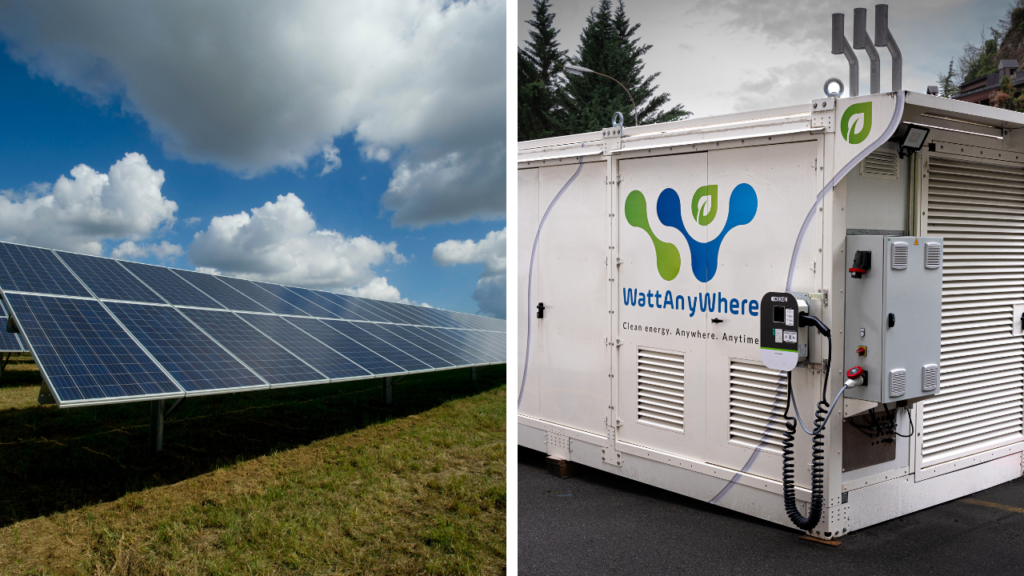
As Distribution System Operators (DSOs) must develop self-consumption communities and microgrids with renewable energy, construction companies need to execute their decarbonization strategies, retailers need to provide charge points to their customers that require hundreds more kW, and mobility operators move toward clean and reliable energy, one question comes up again and again:
Is solar + battery storage enough – or is there a better way to guarantee affordable, 24/7 power?
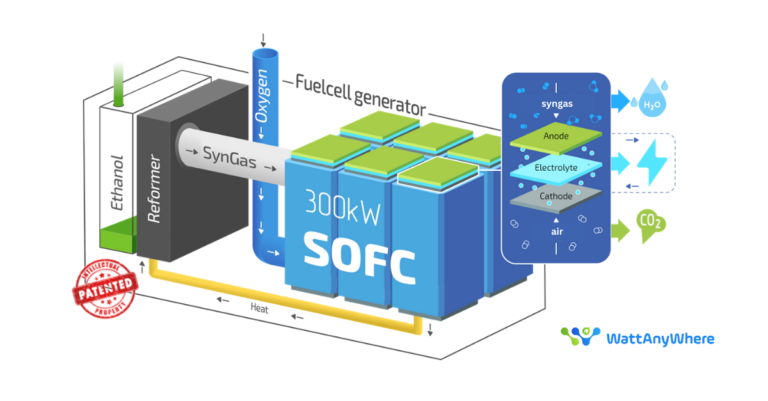
At WattAnyWhere, we believe the answer lies in complementarity – combining renewables with dispatchable, clean technologies such as our ethanol fuel cell .
From Innovation to Real-World Demonstration
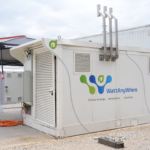
After several autonomous tests, WattAnyWhere completed a live demonstration of its renewable-ethanol genset at the Shell station Aire de Val Neuvy (A10, France), with the support of Shell.
The ethanol genset produced up to 12 kW of low-carbon electricity, validating its simplicity (installation in under two days), reliability, and ability to strengthen site resilience while replacing diesel gensets.
This demonstration – detailed in the press release here – confirms that WattAnyWhere’s solution is moving from R&D to real-world deployment for high-demand energy users.
An upcoming pilot with E.Leclerc Valdahon will power the store’s cold chain and EV infrastructure using renewable ethanol, proving the system’s reliability and cost advantages while exploiting the full value of already deployed PV panels.
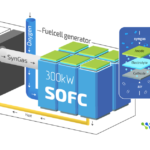
Following successful demonstrations, WattAnyWhere is going towards preparing the 300 kW genset – enough to power an entire commercial site or multiple ultra-fast EV chargers.
Solar + Batteries or Fuel Cells?
Many organizations evaluating off-grid or hybrid microgrids face the same trade-offs:
Metric | Solar + Battery | WattAnyWhere ethanol genset |
Availability | Variable; depends on sun + battery storage | Continuous, 24/7 dispatchable power |
Efficiency | Solar conversion ~15–22 % | SOFC efficiencies > 60 %; less energy loss |
Footprint | Large land or rooftop area | Compact genset + ethanol tank either on surface or underground |
CAPEX | High panels + battery cost | Lower CAPEX vs large solar + storage – leasing option |
OPEX | High kWh cost from the grid, Battery replacement, PV maintenance | Predictable fuel cost (below 10–15 cents/kWh depending on ethanol price), lower maintenance |
Scalability | Adding storage increases complexity | Modular containers add power easily |
Emissions | CO₂ avoidance credits; manufacturing outside EU | CO₂ avoidance credits; clean by-products e.g. pure water |
Integration | Works alone; storage needed for backup | Complements solar/wind in hybrid microgrids |
Evidence & Research Supporting Ethanol SOFC Technology
Independent studies and our own engineering data confirm that solid oxide fuel cells (SOFC) using renewable ethanol can achieve >60 % electrical efficiency – among the highest of any clean power system.
SOFCs are also fuel-flexible, not requiring pure hydrogen, simplifying logistics and infrastructure.
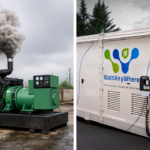
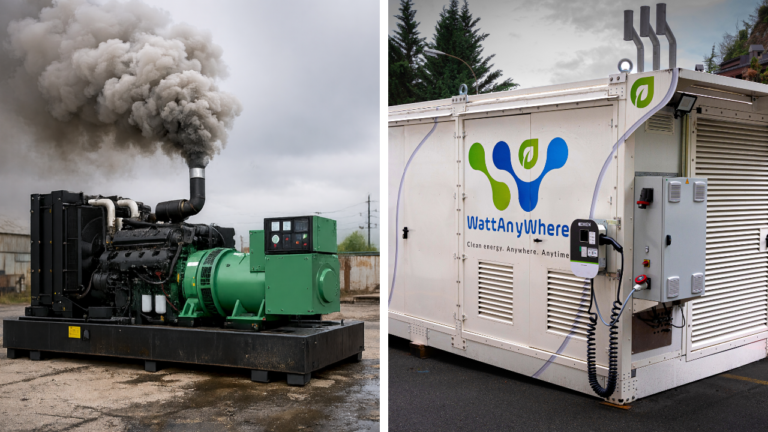
Compared to diesel gensets or oversized battery systems:
- Land footprint can be reduced by up to 90%; ethanol is liquid and safe to store.
- Lifecycle CO₂ emissions are reduced by 90–95%, with negligible NOₓ, SOₓ, and particulates.
- Operating costs remain predictable and 2 to 3 times lower for a genset operating 24/7 at an average 75% utilization rate.
A simulation for a 2,000 m² supermarket shows the challenge solar + storage alone faces:
PV contributes ~208 MWh/year, while total demand (store + EV charging) exceeds 1,200 MWh.
A WattAnyWhere genset (150–300 kW) can cost-effectively bridge this gap, ensuring reliability and scalability.
When Solar + Battery Still Makes Sense
Solar + battery remains an excellent solution for sites with:
- Very high solar exposure and stable demand
- Favorable subsidy regimes
- Limited or expensive fuel logistics
But for most micro-grid configurations at commercial, retail, and industrial operators – where space, uptime, and reliability are critical – WattAnyWhere offers better overall value.
Microgrids: The Best of Both Worlds
WattAnyWhere integrates seamlessly in hybrid microgrids, combining with solar and wind to ensure clean, continuous power:
- Solar/wind first: capture zero‐cost energy when available.
- WattAnyWhere genset provides adjustable baseload power to fill-in during nights, cloudy periods, or low wind.
- Control systems manage switching, storage, etc., so battery size can be optimized to cover only shorter durations (instead of full nights + bad weather).
- Use of by-product heat (from SOFC waste heat) for heating or industrial processes can increase overall system efficiency.
Potential Challenges & How WattAnyWhere Addresses Them
It’s useful to admit possible drawbacks and how they are handled.
Challenge | How WattAnyWhere addresses it |
Ethanol supply chain / fuel logistics | Using renewable ethanol from biomass residues (Europe’s total production has an equivalent of 36 TWh annually); using existing ethanol infrastructure; modular containers help make deployment easier. |
Fuel cost volatility | Ethanol prices are more stable in many places; because system is efficient, volume of fuel needed is lower than with diesel. Also can store fuel, smoothing supply. |
SOFC system temperature, start-up time, durability | Engineering design (good thermal management, pre-heating, robust materials) improves reliability; SOFCs are fuel flexible and over time the technology has matured with improved lifetimes. |
Regulatory / permitting / safety issues with fuel storage | Existing standards for ethanol storage; by staying within safety norms and choosing properly designed tanks, these risks are manageable and low cost |
Where WattAnyWhere Delivers Immediate Value
WattAnyWhere’s ethanol SOFC genset brings strong advantages to sectors where reliability, limited space, and decarbonization matter most. Key use cases include:
- EV Charging: Deploy fast chargers anywhere without waiting for costly or slow grid upgrades. A 150–300 kW SOFC can support multiple ultra-fast chargers.
- Retail & Supermarkets: Power cold chain, store operations, and EV chargers with clean, reliable energy – ideal where rooftop space is limited.
- Logistics & Warehouses: Ensure 24/7 operations where the grid is weak or expansion is expensive. Silent, low-emission, and modular.
- Remote or Off-Grid Sites: Replace diesel gensets for telecom, agriculture, festivals, construction, humanitarian activities and industrial operations needing dependable clean power.
- Data Centers & AI Power Demand: As AI workloads drive surging energy demand, many edge data centers face grid constraints. WattAnyWhere provides scalable, low-carbon, dispatchable power where grid upgrades aren’t possible or fast enough.
- Hybrid Microgrids: Combine with solar/wind to reduce battery size, enhance resilience, and provide stable night-time and low-wind power.
These applications show how WattAnyWhere offers practical, immediate benefits for organizations seeking clean, continuous energy autonomy.
Clean Energy. Real Power. Anywhere.
Therefore, for many businesses, especially in sectors with 24/7 power demand, the choice is no longer “solar or fuel cell” but “solar plus fuel cell” – or using fuel cell as primary (where space is large enough) with renewables helping when available. Either way, WattAnyWhere is positioned to deliver clean, reliable, affordable energy autonomy.
If you are running:
- Off-grid commercial / industrial sites needing reliable clean 24/7 power
- Renewable microgrid projects that want to reduce battery/storage costs while maintaining uptime
… reach out to us at www.wattanywhere.com/contact to explore a feasibility study, get a customized design, or see how our ethanol SOFC gensets can integrate into your energy plans.